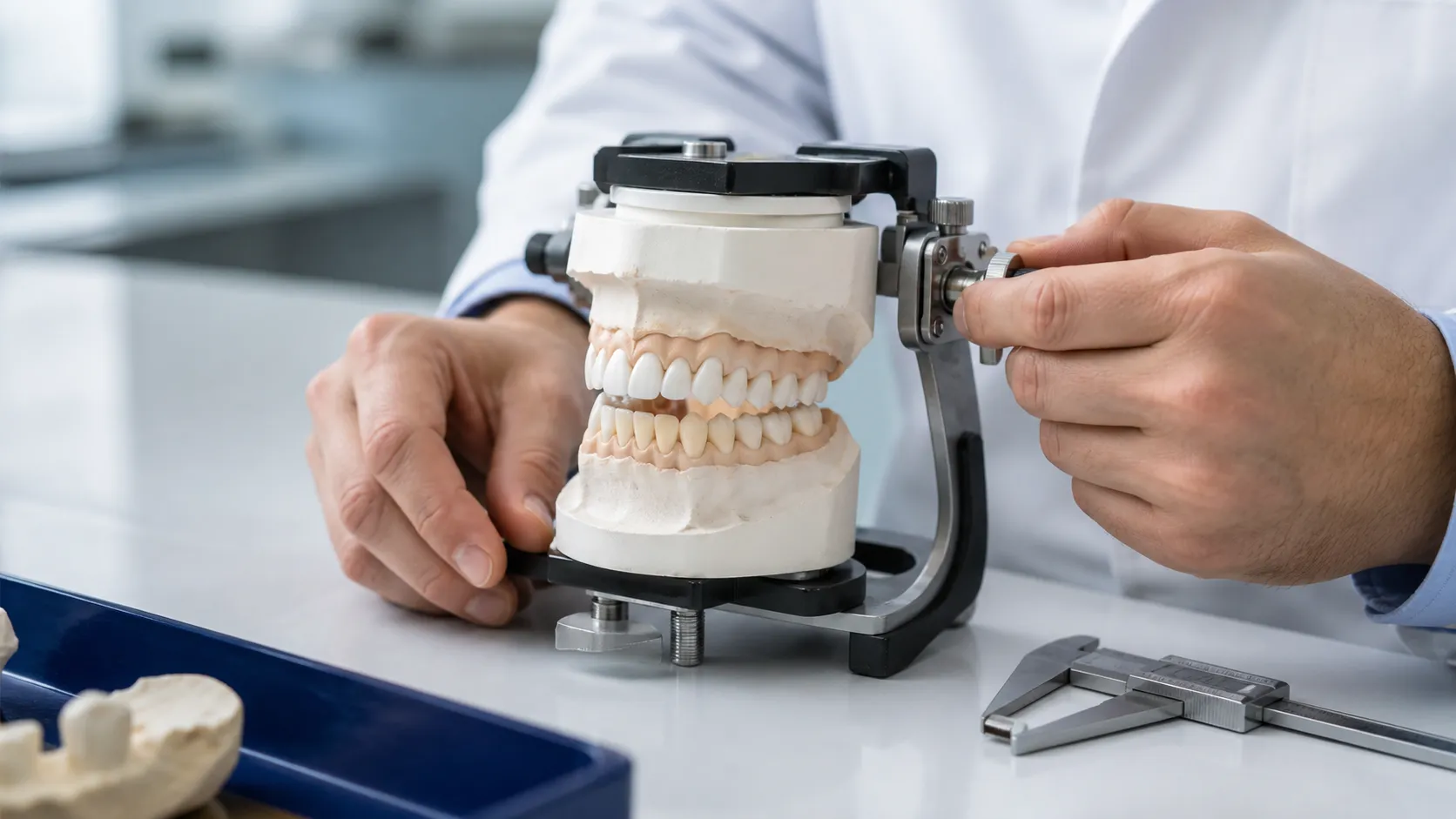
Malocclusion means the teeth or jaws do not meet in the expected relationship when a person bites. Some variations are minor and need no treatment; others may affect chewing, speech, tooth wear, oral hygiene, jaw function, appearance, or long-term dental health. Only a licensed clinician can diagnose a patient and decide whether treatment is appropriate.
This is a standalone clinical vocabulary guide, separate from the health insurance glossary. It explains how terms are used, why they matter, and what effects a provider may evaluate. It is not a checklist for proving coverage.
Occlusion
Definition: Occlusion is the way the upper and lower teeth contact and function together when the jaw closes and moves.
Real-life example: A dentist asks the patient to bite normally while checking how the back teeth and front teeth meet.
Why it matters and possible effects: Occlusion can influence chewing efficiency, tooth loading, wear, stability, and jaw comfort. There is natural variation, and an unusual contact does not automatically require treatment.
Malocclusion
Definition: Malocclusion is a misalignment of teeth, jaws, or their bite relationship.
Real-life example: A clinician documents crowding and a crossbite that makes it difficult for a patient to bite evenly.
Why it matters and possible effects: Depending on type and severity, malocclusion may contribute to chewing difficulty, uneven wear, trauma to teeth or soft tissue, cleaning difficulty, speech concerns, or facial imbalance. Many cases are mild; diagnosis requires history, examination, and appropriate records.
Dental malocclusion
Definition: Dental malocclusion primarily involves tooth position within otherwise reasonably related jaws.
Real-life example: The jaws align acceptably, but several teeth are rotated or crowded.
Why it matters and possible effects: Tooth position can affect cleaning, wear, appearance, and function. Orthodontic tooth movement may be considered when the provider determines it is appropriate.
Skeletal malocclusion
Definition: Skeletal malocclusion primarily involves the size, position, or relationship of the upper and lower jaws.
Real-life example: The lower jaw is positioned substantially behind the upper jaw, affecting the facial profile and bite.
Why it matters and possible effects: Skeletal relationships can affect function, airway evaluation, facial balance, and treatment options. Growth status and severity influence whether orthodontic, growth-modification, surgical, or no treatment is considered.
Angle Class I
Definition: Class I describes a molar relationship that is generally considered normal even though individual teeth may still be crowded, spaced, rotated, or otherwise misaligned.
Real-life example: The back-tooth relationship is Class I, but the lower front teeth are crowded.
Why it matters and possible effects: The class describes one relationship, not the whole diagnosis. It does not prove that function is normal or abnormal.
Angle Class II
Definition: Class II describes a relationship in which the lower dental arch or jaw is positioned relatively behind the upper arch or jaw.
Real-life example: The upper front teeth appear prominent because of tooth position, jaw relationship, or both.
Why it matters and possible effects: Some Class II patterns increase front-tooth injury risk, lip-closure difficulty, or chewing concerns. The provider distinguishes dental from skeletal causes and evaluates growth and function.
Angle Class III
Definition: Class III describes a relationship in which the lower dental arch or jaw is positioned relatively ahead of the upper arch or jaw.
Real-life example: The lower front teeth sit in front of the upper front teeth when the patient bites.
Why it matters and possible effects: The pattern may affect biting, chewing, speech, tooth wear, or facial balance. Severity can range from a local tooth crossbite to a larger jaw discrepancy.
Overjet
Definition: Overjet is the horizontal distance between the upper and lower front teeth.
Real-life example: The upper incisors project several millimeters in front of the lower incisors.
Why it matters and possible effects: Excessive overjet may increase incisor trauma risk or affect lip closure. Reverse overjet can appear in a Class III pattern. Measurement is only one part of diagnosis.
Overbite
Definition: Overbite is the vertical overlap of the upper front teeth over the lower front teeth.
Real-life example: The upper incisors cover a large portion of the lower incisors when the patient closes.
Why it matters and possible effects: A deep overbite may contribute to tooth wear or soft-tissue contact. Too little overlap may accompany an open bite. “Overbite” and “overjet” should not be used interchangeably.
Deep bite
Definition: A deep bite is excessive vertical overlap of the front teeth.
Real-life example: The lower incisors are barely visible when the patient bites.
Why it matters and possible effects: In some patients it can contribute to incisor wear, gum trauma, or restricted functional contacts. Severity and symptoms determine clinical significance.
Underbite
Definition: Underbite is the common-language term for a bite in which lower front teeth sit ahead of upper front teeth, often reflecting anterior crossbite or a Class III relationship.
Real-life example: A patient closes and the lower incisors overlap in front of the upper incisors.
Why it matters and possible effects: It may affect biting into food, tooth wear, speech, jaw function, or facial balance. The provider determines whether the cause is dental, skeletal, functional, or mixed.
Crossbite
Definition: A crossbite occurs when one or more upper teeth bite inside the corresponding lower teeth rather than outside them.
Real-life example: The upper back teeth sit toward the tongue relative to the lower back teeth on one side.
Why it matters and possible effects: Crossbite may be anterior or posterior and unilateral or bilateral. It can be associated with uneven wear, gum stress, functional jaw shifting, or asymmetry, but not every crossbite causes symptoms.
Open bite
Definition: An open bite is a lack of vertical contact between opposing teeth when other teeth are together.
Real-life example: The front teeth do not meet, leaving a gap when the back teeth are closed.
Why it matters and possible effects: It may affect biting, speech, swallowing pattern, or chewing. Causes can include tooth position, jaw growth, habits, or muscular function.
Crowding
Definition: Crowding occurs when there is insufficient arch space for teeth to align normally.
Real-life example: Lower incisors overlap or rotate because the available space is limited.
Why it matters and possible effects: Crowding can make cleaning harder and may affect gum health, tooth wear, and appearance. Space analysis and periodontal condition help guide treatment decisions.
Spacing and diastema
Definition: Spacing is excess space between teeth. A diastema is a visible space, commonly between the upper front teeth.
Real-life example: A gap remains between the central incisors after the other permanent teeth have erupted.
Why it matters and possible effects: Spacing may be harmless or relate to tooth size, missing teeth, frenum attachment, habits, or gum disease. The cause matters before closure is considered.
Midline discrepancy
Definition: A midline discrepancy means the center line of the upper teeth, lower teeth, or face does not align as expected.
Real-life example: The lower dental midline shifts to one side when the patient closes.
Why it matters and possible effects: It can reflect tooth position, missing teeth, asymmetric space, jaw shift, or skeletal asymmetry. The provider evaluates whether it is stable, functional, or progressive.
Rotation
Definition: Rotation is a tooth turned around its long axis.
Real-life example: A premolar faces partly sideways within the arch.
Why it matters and possible effects: Rotation can affect contacts, cleaning, appearance, and available space. It may recur after correction if retention and contributing factors are not addressed.
Impaction
Definition: An impacted tooth is blocked from erupting normally or remains partly or fully within bone or soft tissue.
Real-life example: A canine is positioned above adjacent roots and cannot enter the arch without treatment.
Why it matters and possible effects: Impaction may affect neighboring roots, eruption, cyst risk, infection, or treatment complexity. Imaging selection and management are provider decisions.
Retrognathia and prognathia
Definition: Retrognathia describes a jaw positioned relatively behind; prognathia describes a jaw positioned relatively forward. Either upper or lower jaw may be involved.
Real-life example: A clinician notes mandibular retrognathia rather than calling every prominent upper-tooth appearance an “overbite.”
Why it matters and possible effects: Jaw position can influence facial profile, occlusion, function, and sometimes airway evaluation. These terms describe relationships and do not by themselves diagnose cause or need for surgery.
Functional shift
Definition: A functional shift occurs when the jaw moves away from its initial closing path to find a more comfortable tooth contact.
Real-life example: The lower jaw slides sideways as the patient closes because of an interfering contact.
Why it matters and possible effects: A persistent shift may contribute to asymmetric function or growth in a developing patient. The clinician distinguishes functional movement from fixed skeletal asymmetry.
Orthodontics
Definition: Orthodontics is the dental specialty concerned with diagnosing, preventing, and correcting malpositioned teeth and jaws.
Real-life example: An orthodontist uses examination, photographs, models, and selected imaging to plan tooth movement.
Why it matters and possible effects: Orthodontic treatment can improve alignment and function when appropriate. Risks, stability, oral hygiene, root health, periodontal support, and retention require individual assessment.
Orthognathic surgery
Definition: Orthognathic surgery repositions jaw bones to address selected skeletal and functional problems, often with orthodontic coordination.
Real-life example: A multidisciplinary team evaluates an adult with a severe skeletal discrepancy that cannot be corrected by tooth movement alone.
Why it matters and possible effects: It can change bite, function, airway dimensions, and facial balance, but it is major surgery with patient-specific risks and alternatives. Coverage is a separate payer decision. See medical billing for orthognathic surgery.
Cephalometric analysis
Definition: Cephalometric analysis uses standardized head imaging and measurements to evaluate craniofacial and dental relationships.
Real-life example: An orthodontist evaluates a lateral cephalometric radiograph as part of a larger examination.
Why it matters and possible effects: It supports diagnosis and treatment planning but does not replace clinical examination. The provider chooses the necessary views; routine left-and-right duplication is not required for every patient.
The dental imaging glossary explains lateral and frontal cephalometric views and why the provider selects them patient by patient.
Temporomandibular joint and temporomandibular disorder
Definition: The temporomandibular joint, or TMJ, connects the lower jaw to the skull. Temporomandibular disorder, or TMD, is a group of conditions affecting the joint, muscles, or related structures.
Real-life example: A patient with jaw pain receives a TMD evaluation rather than being told that malocclusion alone explains the symptoms.
Why it matters and possible effects: Bite findings and TMD symptoms can coexist, but one does not automatically cause the other. Diagnosis should consider history, muscles, joints, function, and other causes.
How is malocclusion evaluated?
A dentist, orthodontist, or oral and maxillofacial surgeon may use history, clinical examination, bite assessment, photographs, dental models or scans, and patient-specific imaging. The MedlinePlus malocclusion overview explains that most alignment problems are found during dental examination and that many are minor. The provider decides what is clinically necessary and explains treatment options, risks, alternatives, and whether observation is reasonable.
This glossary is educational and is not a diagnosis, treatment recommendation, medical-necessity determination, or coverage statement. Symptoms and effects vary. Seek evaluation from an appropriately licensed dental professional.