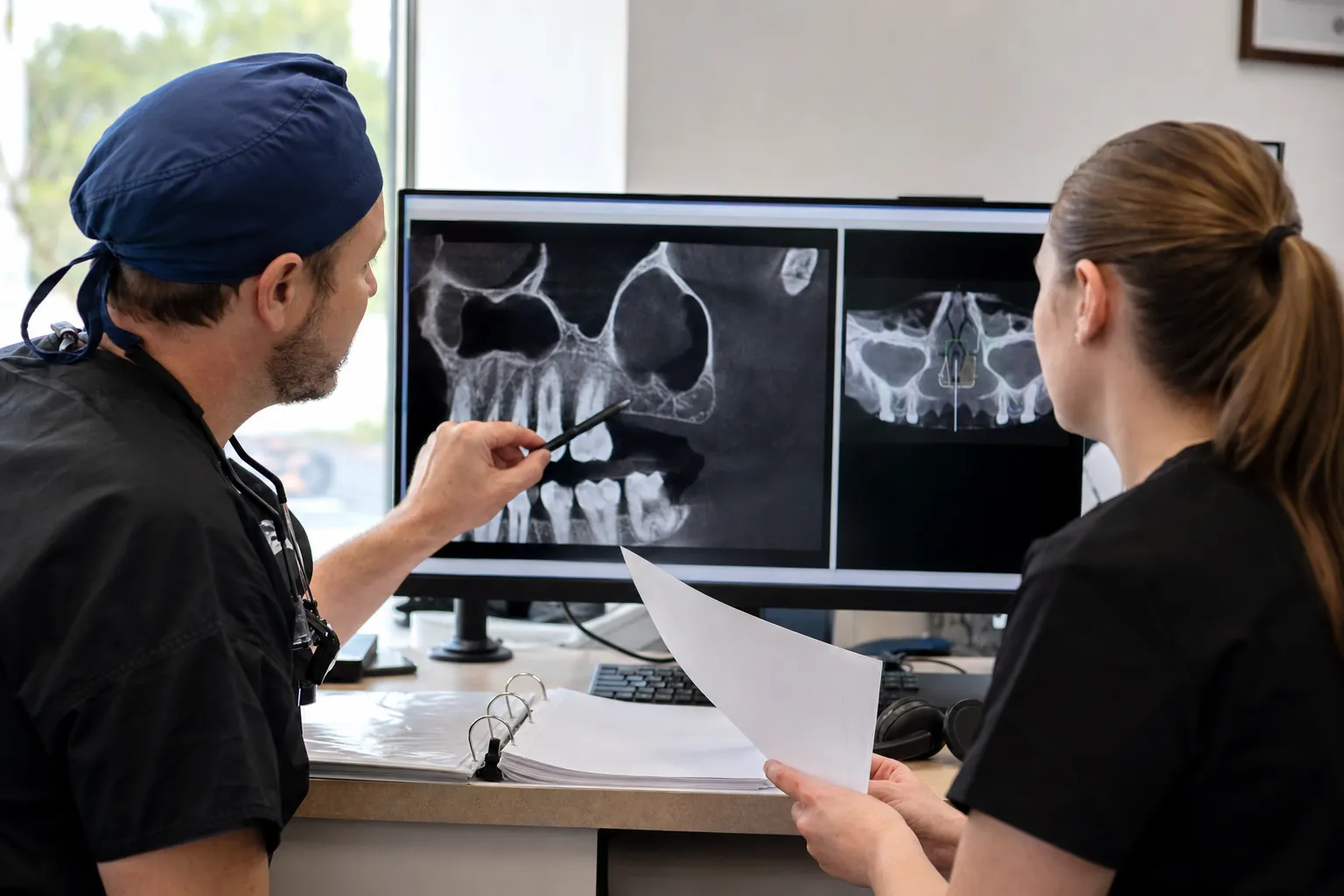
Sinus lift and bone graft procedures can involve different services, sites, materials, and purposes. A practice must verify the exact product and written payer rules before deciding whether a medical claim is appropriate.
Many dental practices see the terms sinus lift and bone graft and wonder about medical billing. These labels can describe many different clinical situations. The answer is never automatic. It always depends on what was done, why, where, by whom, and what the specific plan's written terms say. This guide walks through the administrative steps a practice can take to verify coverage and build a clean claim.
What makes a sinus lift or bone graft potentially eligible for a medical claim?
Eligibility is not about the procedure name. It is about the exact service, site, material, purpose, phase, and setting as documented in the record.
The procedure label alone does not establish a benefit pathway. The practice must separate each documented component and check the written product terms for the exact scenario. Administrative staff should not infer a covered relationship from an implant plan, trauma history, or other clinical fact.
What steps should a practice take before submitting any medical claim?
The practice should verify eligibility, benefits, and written coverage rules for each distinct service, provider, and setting.
Start with the patient's exact product and effective date. Confirm the status of each provider and facility. Then check the written dental and medical benefit terms. Record any exclusion, exception, referral, and pre-service language that applies. Preserve the date and reference details for each payer response. A verbal response should not be treated as broader than the information actually supplied.
What documentation supports a clean medical claim for these procedures?
The administrative file should connect provider-authored records with the exact services and the payer's written request.
The record should show the exact service, site, material, purpose, and phase. Include provider-authored rationale, relevant history, imaging, and the treatment plan when requested. Any relationship to another medical service must come from the treating professionals' records. It must not be created by administrative staff. Separate the graft or sinus-lift question from the implant, imaging, anesthesia, facility, pathology, membrane, and follow-up questions.
What is an example of a verification process in a real practice?
A planned graft changes material or setting, and the administrative team rechecks the payer's written terms before the procedure date.
Consider a hypothetical scenario. A graft is planned in the surgeon's office with one documented material. The practice receives a pre-service response for those facts. Later, the provider changes the material, and the setting moves to a facility. The administrative team uses the payer's stated process to ask whether the existing response still applies or a new review is needed. Staff update the file and do not assume approval or denial.
How do Medicare rules fit into this picture?
Medicare provides a narrow, program-specific example that does not set the standard for commercial plans.
CMS guidance explains that Medicare generally excludes dental services. Even a potentially payable dental service requires a documented inextricable link and coordination with another covered medical service. See CMS guidance on Medicare dental coverage. This is one federal program's rule. A commercial plan, a Medicaid managed care plan, or a workers' compensation program will have its own written definitions. A practice should never assume that Medicare's limited exceptions apply to any other plan.
What happens after a claim is submitted?
Authorization and benefit verification do not guarantee payment. The practice should track every claim and pursue timely authorized challenge paths.
Once submitted, monitor the claim acknowledgment. Respond quickly to any documentation requests. When the remittance arrives, review the adjudication carefully. If a service is denied or paid differently than expected, check the explanation of benefits against the written policy you collected earlier. Follow the plan's authorized appeal or reconsideration path within the stated deadlines. Keep a log of every step. This creates a clear record if the issue needs further review.
Frequently asked questions
Are the graft and implant one medical-claim question?
They are separate administrative questions. The graft, implant, imaging, anesthesia, facility, and materials may involve different facts and written terms. The practice should identify each item and date without assuming that one payer response controls the others.
Does a pre-authorization mean the service will be paid?
No. Authorization is a review of planned services against the plan's clinical policy. It is not a payment guarantee. Final adjudication depends on the actual claim, eligibility, records, written terms, and other applicable requirements. The practice should follow its established process for checking current eligibility.
This guide is general administrative information, not legal, clinical, medical, coding, financial, accounting, tax, benefits, enrollment, contract, treatment-planning, patient-billing, or coverage advice, and not a statement that any sinus-lift, graft, implant, material, facility, anesthesia, or related service is necessary, eligible for a medical claim, authorized, covered, payable, or assigned to any party. Requirements and outcomes vary by payer, program, plan, patient, provider, site, service, material, purpose, phase, setting, record, agreement, state, and date.